Accreditation Council for Continuing Medical Education
CME Activity
CONTINUING
MEDICAL
EDUCATION
Module
Fundamentals of Public Health Practice: A Remedial Module for Senior Health Officials
Accreditation Statement
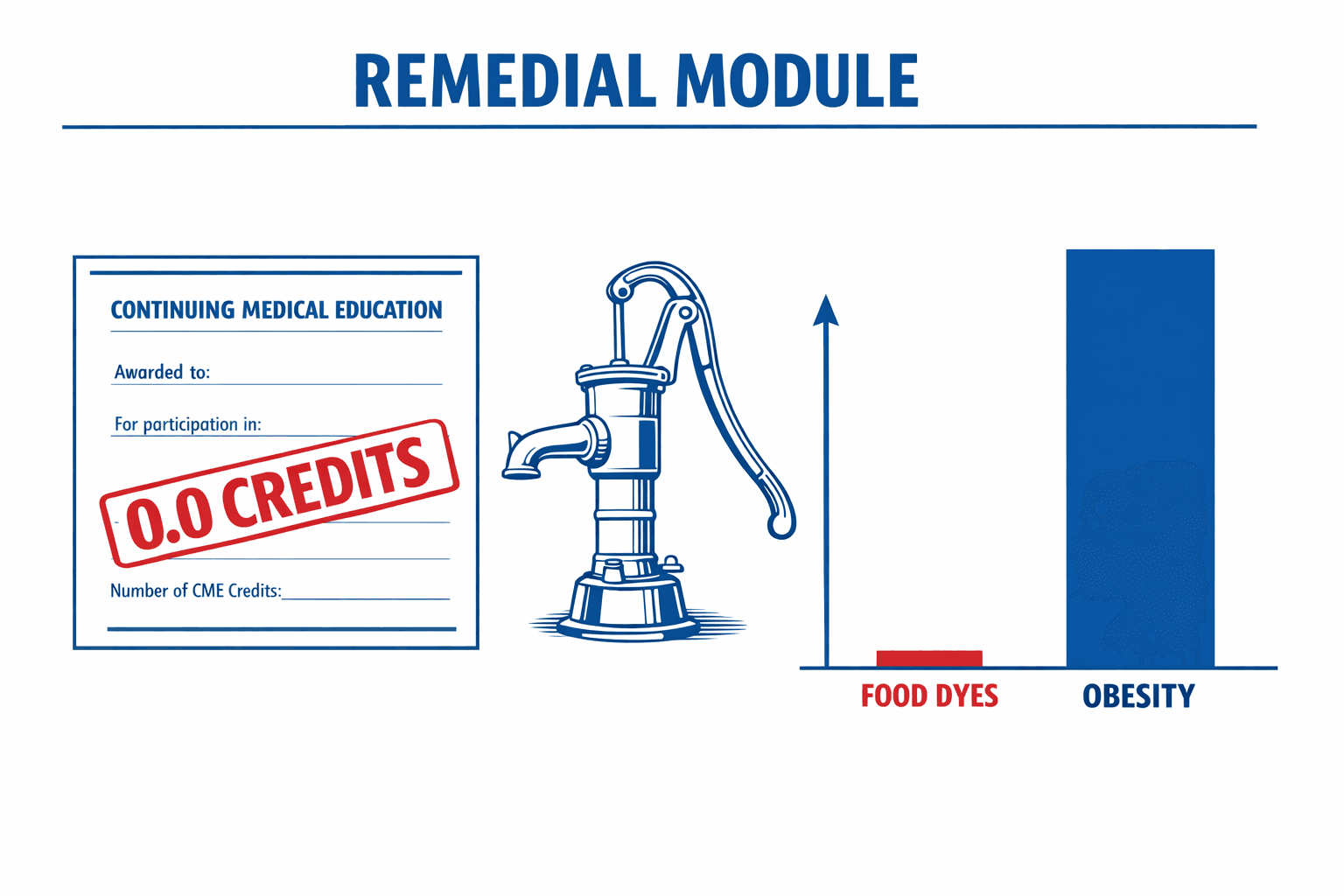
This activity has been reviewed and is acceptable for up to 0.0 AMA PRA Category 1 Credits. The accrediting body was unable to identify a measurable educational outcome, as the target learner has not demonstrated baseline competency in the subject matter.
Faculty & Disclosure
Target Learner
Robert F. Kennedy Jr., JD
Secretary, Department of Health and Human Services
Financial Relationship Disclosure
The target learner founded Children's Health Defense, an anti-vaccine advocacy organization that raised $26 million in 2023. He has not disclosed this relationship in the context of federal health policy decisions. Per ACCME Standard 3, this represents an unmitigated conflict of interest.
Relevant Credentials
Practice Gap / Needs Assessment
The nation's senior health official has publicly conflated individual wellness coaching with population-level public health intervention. He has prioritized food dyes (zero documented deaths per year) over obesity (280,000-500,000 deaths per year), dismantled public health infrastructure while advocating personal responsibility, and questioned systemic interventions -- fluoridation, vaccination, pasteurization -- that represent the most successful health policies in modern history. This module addresses the resulting educational gap.
0Learning Objectives
Upon completion of this activity, the learner should be able to:
Define public health as a population-level discipline distinct from individual clinical medicine or wellness coaching.
Identify at least five systemic interventions (clean water, vaccination, fluoridation, seatbelt laws, smoking regulation) that saved more lives than any individual behavior-change campaign.
Correctly rank modifiable health threats by actual mortality burden rather than social media engagement.
Explain why telling 330 million people to 'eat better' is not a public health strategy.
Recognize that dismantling the institutions that conduct population-level surveillance is the opposite of public health.
1What Is Public Health?
Core Definition
Clinical medicine treats the health issues of an individual patient. Public health prevents health risks across entire populations through systems and policy.
The patient in public health is not a person. It is a population. The treatment is not a prescription. It is a system.
The Broad Street Pump (1854)
John Snow mapped cholera deaths in London's Soho and traced the outbreak to a contaminated public water pump. Homes served by the Southwark and Vauxhall Waterworks Company -- drawing from the sewage-polluted Thames -- had a cholera rate 14 times that of homes with cleaner water.
His intervention: remove the pump handle. He did not tell people to make better water choices. He changed the system.
Snow earned the title “father of modern epidemiology.” His findings inspired the water and sanitation systems that cut infant mortality by three-quarters in the first half of the 20th century.
The Secretary of Health and Human Services oversees a system that serves 330 million people. The job is to manage the pump, not to give 330 million people individual hydration advice.
2Systems vs. Individual Advice
Every major public health achievement in modern history worked through policy and infrastructure -- not by telling individuals to make better choices.
Systemic Interventions: Historical Outcomes
Key Teaching Point
Smoking prevalence dropped from 42% to 12% over 50 years. This happened because of advertising bans, smoke-free indoor air laws, excise taxes, and cessation programs -- systemic interventions. “Just tell people to quit smoking” was tried. It did not work.
The Secretary has asked: “If you're smoking three packs of cigarettes a day, should you expect society to pay when you get sick?” The answer from 50 years of evidence: society should stop you from getting there in the first place. That is the job.
Kennedy, CBS News interview with Jon LaPook, April 2025. Washington Post, April 10, 2025.
The Secretary's Framework
“It is an American's choice to eat donuts all day. But in terms of, should you then expect society to care for you when you predictably get very sick at the same level as somebody who was born with a congenital illness?”
Kennedy, CBS News, April 2025
3Priority Setting by Mortality Burden
A fundamental skill in public health: allocate resources proportional to disease burden. The following table compares annual U.S. deaths by modifiable risk factor against the MAHA initiative's stated priorities.
Mortality Burden vs. MAHA Prioritization
What MAHA Focuses On
Food dyes (0 deaths/year)
Seed oils (0 deaths/year)
Raw milk promotion (840x higher foodborne illness risk)
Fluoride removal (saves $6.5B/year in dental costs)
Supplement deregulation ($70B industry, no FDA testing)
What Actually Kills Americans
Heart disease (683,491 deaths/year)
Cancer (619,876 deaths/year)
Stroke (166,852 deaths/year)
Diabetes (94,445 deaths/year)
Chronic liver disease (52,274 deaths/year)
Expert Assessment
The MAHA initiative “devotes limited attention to well-established determinants of chronic disease such as tobacco use and alcohol consumption, factors supported by a robust body of epidemiological evidence and a precedent of effective regulatory intervention. This omission raises significant concerns regarding the overall comprehensiveness of the initiative.”
Frontiers in Health Services, peer-reviewed analysis, 2025
40% of Americans are obese. Obesity generates 67% more chronic health conditions than normal weight. It is the single largest modifiable driver of the diseases that dominate the top 10 causes of death. Food dyes are not on the list.
CDC NCHS Data Brief 508; RAND Health Research Brief, 2002
4Institutional Outcomes
The following table documents personnel and budget changes to the agencies responsible for U.S. population-level health surveillance, research, food safety, and drug regulation.
Public Health Infrastructure Status
The Secretary's Claim vs. the Evidence
The Secretary
“We're not cutting science.”
PolitiFact
Rated: Pants on Fire.
3,200+ grants terminated. $3 billion in approved funding cut. 160 clinical trials ended. The proposed 2026 NIH budget represents a 40% reduction.
Public health surveillance requires institutions. You cannot track disease outbreaks, monitor food safety, or conduct population-level research by telling individuals to be more careful. The agencies that do this work are the pump handle.
5Case Study: The Food Dye Question
Timeline
1990
FDA banned Red No. 3 in cosmetics and topical drugs. The Delaney Clause required it: the dye caused cancer in male rats. But the FDA left food use intact.
1992
FDA announced intent to revoke Red No. 3 from food. Then decided not to act, citing “resources required.” The dye stayed in food for 33 more years.
January 15, 2025
Biden's FDA revoked authorization for Red No. 3 in food and ingested drugs. Compliance deadline: January 2027 for food, January 2028 for drugs. This was a Biden-era action, not an RFK Jr. action.
April 22, 2025
RFK Jr. announced a plan to phase out eight petroleum-based synthetic dyes by end of 2026. The plan relies on voluntary industry cooperation. No enforcement mechanism exists.
The Proportion Problem
Food Dyes
0
documented deaths/year
Obesity
500,000
deaths/year (Lancet, 2024)
The primary documented concern with food dyes is possible exacerbation of ADHD symptoms in some children. No conclusive evidence exists of broader danger at typical consumption levels. Meanwhile, 40.3% of American adults are obese, driving heart disease, cancer, stroke, and diabetes -- the top four killers.
MD Anderson Cancer Center; UNC Health; CDC NCHS Data Brief 508
Seed Oils: The Evidence
The Secretary
“Seed oils are one of the most unhealthy ingredients that we have in foods.”
Randomized Controlled Trials
When people consume more seed oils, they do not show signs of excess pro-inflammatory compounds and do not have more markers of inflammation. Omega-6 fatty acids in seed oils help lower LDL cholesterol, reducing heart disease risk. The American Heart Association supports their consumption as part of a healthy diet.
NPR, July 2025; The Conversation; American Heart Association
6Post-Test Assessment
Passing score: 70%. Every incorrect option is something the Secretary has said or done.
Question 1
A senior health official observes rising rates of chronic disease. The most effective population-level response is:
Options A and B are individual-level advice, not population-level intervention. Option D reduces the capacity to even measure the problem. Only Option C addresses disease at the systems level. (Source: Kennedy's CBS interview, April 2025; HHS workforce cuts, STAT News, March 2025)
Question 2
Rank the following by annual U.S. mortality burden, highest to lowest:
Smoking: 480,000-490,000 deaths/year. Obesity: 280,000-500,000. Alcohol: 178,000. Food dyes: zero documented deaths. Options A, C, and D reflect the Secretary's stated priorities. (Sources: CDC, Lancet eClinicalMedicine 2024, MD Anderson)
Question 3
John Snow's intervention in the 1854 cholera outbreak was to:
Snow changed the system, not individual behavior. He did not tell Londoners to research their own water sources. He removed the pump handle. (Source: AMA Journal of Ethics, 2009)
Question 4
The Red No. 3 food dye ban was:
The Red No. 3 ban was a Biden-era FDA action. The FDA knew about the carcinogenicity data since 1990 and chose not to act for 33 years, citing 'resources required.' (Source: FDA, Scientific American)
Question 5
The Secretary stated "We're not cutting science." PolitiFact rated this claim:
3,200+ grants terminated. ~$3 billion in approved funding cut. 160 clinical trials ended. Proposed NIH budget represents a 40% reduction. (Source: PolitiFact, November 2025)
7Certificate of Completion
Accreditation Council for Continuing Medical Education
CERTIFICATE OF COMPLETION
AMA PRA Category 1 Credits: 0.0
This certifies that the following individual has completed the Continuing Medical Education module “Fundamentals of Public Health Practice.”
Participant Signature
Date Completed
Post-Test Score
This certificate has not been signed because the target learner has not demonstrated competency in the subject matter. The post-test score of 0/5 falls below the 70% passing threshold. Remediation is recommended. The nation will wait.
John Snow removed the pump handle. He did not tell Londoners to do their own research.
This page is satire formatted as a pharmaceutical document. It is not medical advice. The pharmacology, however, is real.